🕐 Planetary Hours

Calculate the traditional Chaldean planetary hours for any date and place - know which planet rules the current hour for electional timing.

Planetary Hours 1

Overview

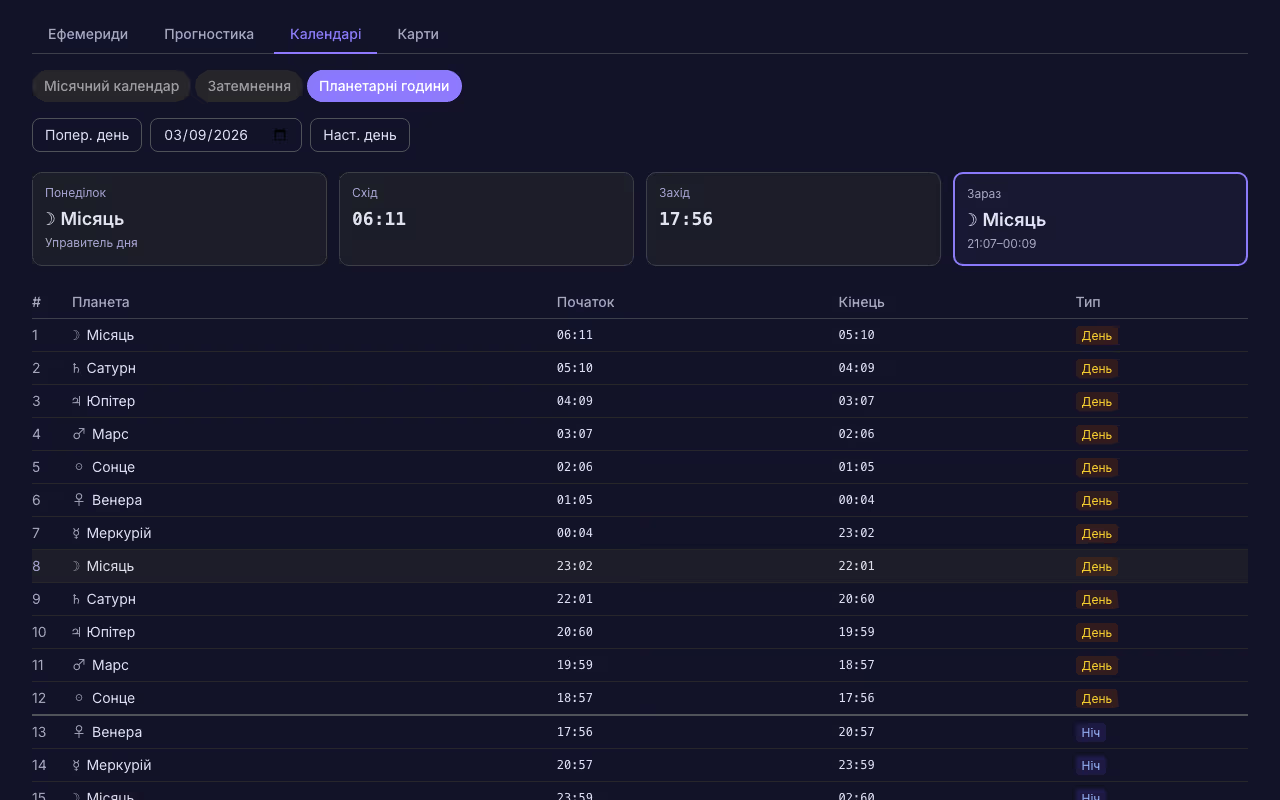
Planetary hours divide the day and night into 12 unequal segments, each ruled by a planet in Chaldean order: - 12 daytime hours (sunrise to sunset) - 12 nighttime hours (sunset to next sunrise) - Each hour ruled by: Saturn, Jupiter, Mars, Sun, Venus, Mercury, Moon (repeating) - Day ruler determined by the day of the week - Current hour clearly highlighted - Exact sunrise and sunset times for your location - Navigate between days - Essential for electional astrology and magical timing - Hour lengths vary by season and latitude

Planetary Hours

A planetary hour is not 60 minutes. The daylight period is divided into twelve equal parts, and the night is also divided into twelve. Therefore, in summer, a daytime hour is longer than 60 minutes, while a nighttime hour is shorter; in winter, the opposite is true.

At the latitude of Kyiv in June, the daytime hour lasts approximately 84 minutes, while the nighttime hour shortens to 36. This is why the table of planetary hours is built for a specific date and city rather than taken as a ready-made reference.

  • 12 hours from sunrise to sunset and 12 from sunset to sunrise
  • Duration of an hour varies by season and latitude.
  • Calculation requires exact sunrise and sunset times for the location.

Chaldean Sequence

Hours progress in descending order of speed: Saturn, Jupiter, Mars, Sun, Venus, Mercury, Moon, and then the cycle repeats. This is the Chaldean order.

The first hour of the day belongs to the ruler of the day of the week: on Sunday to the Sun, on Monday to the Moon, on Tuesday to Mars, and so on. Since 24 is not evenly divisible by 7, the next day automatically begins with the correct planet.

  • Order: Saturn, Jupiter, Mars, Sun, Venus, Mercury, Moon
  • The first hour after sunrise belongs to the day's ruler.
  • The names of the days of the week in many languages originate from this sequence.

Choosing the Right Time

The logic is simple: the matter correlates with the planet’s nature. Mercury hour for negotiations and documents, Venus hour for art and relationships, Mars hour for actions requiring pressure.

A stronger alignment occurs when the hour and day share the same planetary ruler. Friday’s Venus hour is considered the most favorable time for Venusian matters.

  • Mercury: documents, negotiations, education, travel
  • Venus: relationships, art, pleasure shopping
  • Jupiter: agreements, law, appeals to elders
  • Alignment of a planet's hour and day enhances the selection

Planetary Hours and Elections

Planetary hour is the simplest level of elective astrology. A full elective considers the Moon's position, chart angles, and the condition of the significator, while the hour offers only a rough approximation.

That's why hours are used when there's no time for a full calculation, or as an additional filter over an already selected day.

  • An hour is a simplified elective, not its replacement.
  • Moon void of course blocks a favorable hour.
  • Full electives consider the chart angles and the significator.

Method Boundaries

At high latitudes, the method breaks down: during the polar day or night, there is no sunrise or sunset, and dividing into twelve parts loses meaning. As a rough guide, the table should not be constructed above 66 degrees latitude.

The main limitation: the time is the same for everyone in this city. It does not see your chart, so it carries no weight against a strong natal or transit indicator.

  • Polar latitudes make calculation impossible
  • The time is the same for everyone within the city.
  • Personal transits weigh more than planetary hours.
Get started

Start Working in AstroWay App

Create your first natal chart in minutes. Free, precise, and private. 7-day PRO trial included.

Get started