☉ Heliocentric Chart

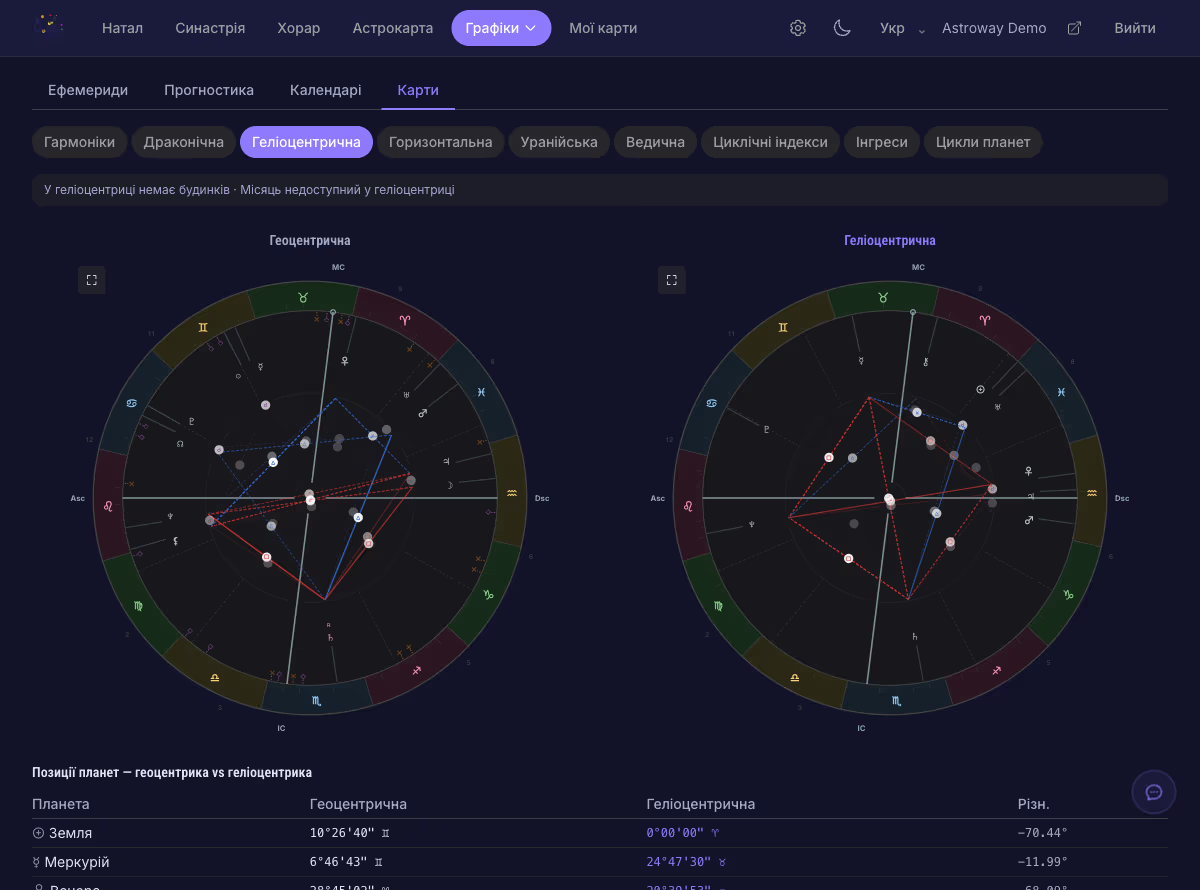
View the Solar System from a different perspective - the heliocentric chart shows true orbital positions of planets relative to the Sun.

Heliocentric Chart 1

Overview

Heliocentric chart - a Sun-centered perspective: - Earth replaces the Sun as one of the planets - Moon unavailable (orbits Earth, not the Sun) - No houses (houses are tied to a location on Earth) - Aspects recalculated between heliocentric positions - Zodiac wheel without house lines - Position table without House column - Aspect grid for heliocentric aspects - Planets: Earth, Mercury, Venus, Mars, Jupiter, Saturn, Uranus, Neptune, Pluto, Chiron - Export to PNG/PDF

Heliocentric Chart

Standard geocentric chart: the observer is on Earth and sees the movement of the planets from there. The heliocentric chart shifts the reference point to the center of the Solar System, so the planets are positioned as they would appear to an observer on the Sun.

Direct effects. The Sun is not present in such a chart because it is at the center. Neither is the Moon, as it orbits the Earth rather than the Sun. Instead, the Earth itself appears, always positioned exactly opposite the geocentric Sun.

  • No Sun or Moon, instead there is Earth
  • Heliocentric Earth is in opposition to geocentric Sun
  • No retrograde motion: it is a result of the view from Earth.

Retrograde Disappearance

Retrograde motion is an optical effect: Earth overtakes an outer planet, making it appear to move backward. From the Sun, this effect does not occur; all planets move forward uniformly.

This is why heliocentric positions differ from geocentric ones more strongly the closer a planet is to retrograde. For Mercury, the discrepancy reaches tens of degrees, while for Pluto it is small.

  • All planets are moving direct; there are no stations or loops.
  • The greatest discrepancy with the geocentric chart is in Mercury and Venus.
  • Planet's speed is stationary, so cycles are uniform.

Houses and Angles

Ascendant and Midheaven depend on Earth's axial rotation, i.e. the observer's location on its surface. In the heliocentric system, such a point does not exist, so classical houses are absent there as well.

Thus, the heliocentric chart is read as a set of signs and aspects. Attempts to overlay houses onto it exist, but there is no shared tradition for this.

  • Angles in the heliocentric chart are undefined.
  • Aspects, signs and cycles are being read
  • Accurate birth time is less critical than in a geocentric chart.

Effective Methods

Heliocentric data works most convincingly where pure cycles are needed: planetary conjunctions, synodic periods, and long-term rhythms. Without retrograde loops, conjunction dates are unambiguous.

Therefore, it is often used in mundane astrology and cycle research rather than in personal chart analysis.

  • Exact conjunction dates without triple passes
  • Synodic cycles of Jupiter and Saturn in pure form
  • Mundane and cyclical studies

Limitations

The tradition of interpreting the heliocentric chart is sparse: classical sources do not recognize it, and modern texts most often transfer geocentric meanings without verification.

It makes practical sense to use it as a second opinion on the chart rather than a replacement. A conclusion that contradicts the geocentric chart requires separate justification.

  • There is no classical interpretation tradition.
  • Values are transferred from geocentric without separate verification.
  • Used as a supplement, not as the primary chart
Get started

Start Working in AstroWay App

Create your first natal chart in minutes. Free, precise, and private. 7-day PRO trial included.

Get started