Overview
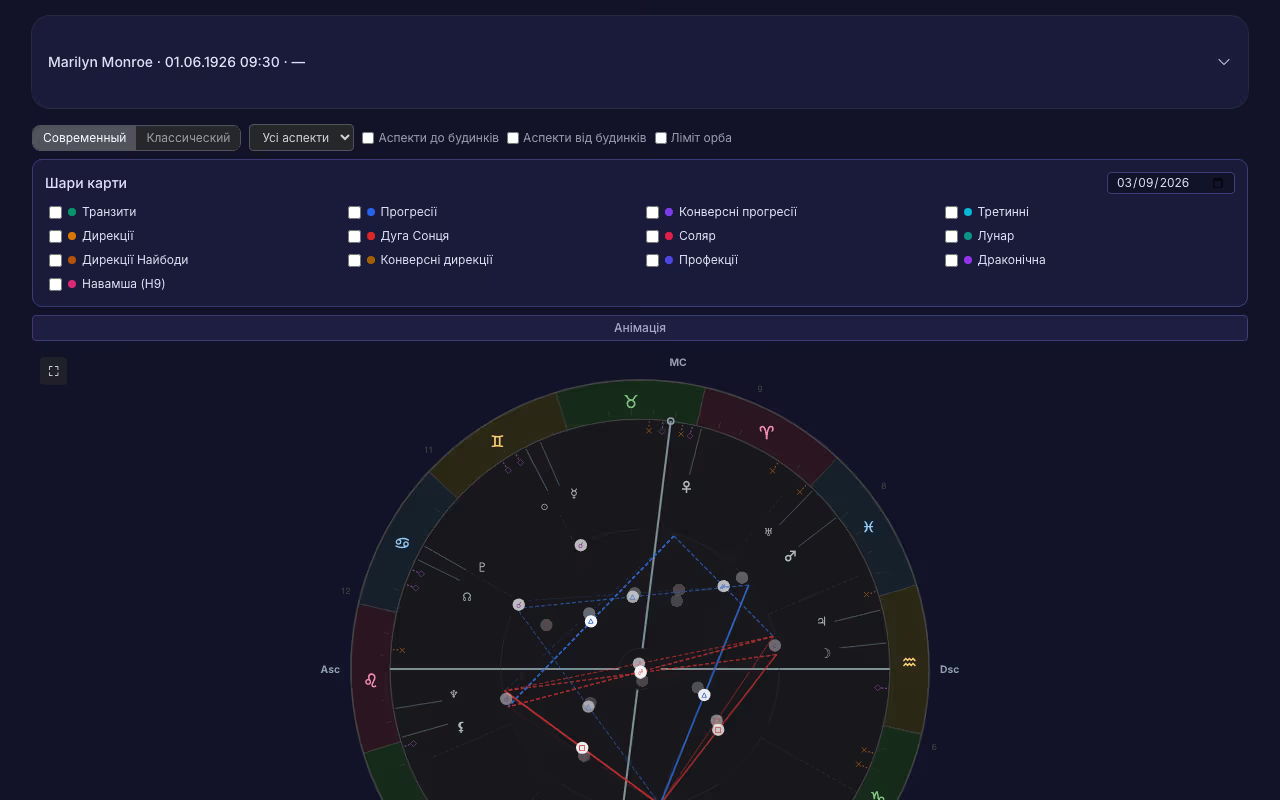
The natal chart is the foundation of astrological practice. AstroWay calculates a complete birth chart using Swiss Ephemeris directly in your browser - no data is sent to any server.
Enter birth date, time, and location to get:
- Interactive SVG chart wheel with zodiac ring and aspect lines
- Full planet coordinate table with longitude, latitude, declination, and speed
- Aspect grid with orbs, applying/separating indicators
- House cusps in your chosen house system
Planet Positions
Accurate positions for all major bodies:
- Sun, Moon, Mercury, Venus, Mars, Jupiter, Saturn, Uranus, Neptune, Pluto
- True Node, Mean Lilith, Chiron
- 5 major asteroids: Ceres, Pallas, Juno, Vesta, Pholus
- Uranian points: Cupido, Hades, Zeus, Kronos, Apollon, Admetos, Vulcanus, Poseidon
- Part of Fortune and custom Arabic lots
All positions include longitude, latitude, declination, daily speed, and retrograde status.
House Systems
AstroWay supports 12+ house systems:
- Placidus, Koch, Regiomontanus, Campanus
- Whole Sign Houses, Equal Houses
- Porphyry, Alcabitius, Morinus
- Topocentric, Krusinski
- Meridian (Axial Rotation)
Switch between systems instantly - the chart wheel and all tables update in real time.
Aspects & Orbs
Full aspect analysis with customizable orbs:
- Major aspects: conjunction, opposition, trine, square, sextile
- Minor aspects: semisextile, quincunx, semisquare, sesquisquare
- Harmonic aspects: quintile, biquintile, septile, novile
- Declination parallels and contra-parallels
- Antiscia and contra-antiscia
- Aspects to house cusps
Each aspect shows exact orb, applying/separating status, and can be filtered by type.
Additional Data
Beyond the basic chart:
- 170+ fixed stars with magnitude and aspects to planets
- 7 collections of Arabic parts/lots (500+ formulas)
- Sabian symbols for each degree
- Disposition chains (by rulership and detriment)
- Declination strip (-30° to +30°)
- Gauquelin sectors
- Midpoint table with interpretations
- Planetary sect (diurnal/nocturnal)
- Planetary phases (oriental/occidental)
Export & Reports
Export your charts in multiple formats:
- PNG - high-resolution chart wheel image (Retina 2x)
- PDF - full report with chart, tables, and interpretations
- DOCX - editable report for client consultations
- CSV - raw data for analysis
- JSON - portable chart data format
Import charts from JSON, CSV, or ZET 9 (.zbs) format.
Components of Natal Chart
A natal chart is a snapshot of the sky at the moment of birth from a specific point on Earth. It consists of three layers: the positions of planets in signs, the division of the chart into houses, and the aspects between planets.
Planets in signs are the same for everyone born on this day, while houses depend on time and place down to the minute. It is the houses that make the chart individual.
- •Planets in signs: how each function manifests
- •Houses: in which area of life this happens
- •Aspects: how functions interact with each other
Precise Time Matters
Ascendant moves approximately 1 degree every 4 minutes, so it takes less than 2 hours to pass through a full sign. A 30-minute error shifts the angle by 7 degrees and may move it into the adjacent sign.
The Moon is moving quickly, up to 15 degrees per day. In two hours, it travels over one degree, so precise aspects and house cusps require birth time accuracy to the minute.
- •Ascendant: 1° every 4 minutes
- •Moon: up to 15° per day
- •Slow planets' signs only work without birth time.
House Systems
Placidus, Koch, Regiomontanus, Campanus, equal house and whole sign systems divide space differently and yield different cusps. A planet near a house boundary may fall into different houses depending on the choice.
In high latitudes, quadrant systems break down: above approximately 66 degrees, the Placidus system may not yield a solution. There, the equal house or whole sign system is used.
- •Placidus is the most common system in European tradition.
- •Whole-sign system returns from Hellenistic practice
- •Above 66° latitude, quadrant systems are unreliable.
- •Ascendant and Midheaven are the same in all systems except the Whole Sign system.
Analysis Order
The logical sequence is: Ascendant and its ruler first, then Sun and Moon by sign and house, then the strongest planet by dignity, and only then aspects.
Beginner’s mistake is to start with rare details: asteroids, minor aspects, exotic points. They won’t change the picture if the basic structure isn’t read first.
- •Ascendant and its ruler set the framework
- •Sun and Moon by sign, house, and phase
- •Planet with the highest dignity as the leading theme
- •Aspect patterns after the main structure
Why Card Not Showing
The chart does not contain biographical facts: it has no names, professions, dates of events, or number of children. It describes structure, not plot, so one configuration is realized differently in different conditions.
Therefore, any interpretation formulated as a categorical prediction of a specific event goes beyond what the chart is able to provide.
- •The chart describes structure, not events with dates
- •One configuration is implemented differently
- •For dating, transits, progressions and directions are needed