
∿ Cyclic Indices

The Barbault cyclic index measures the sum of angular separations between outer planets - a key tool in mundane astrology for tracking global cycles and trends.

Cyclic Indices 1

Overview

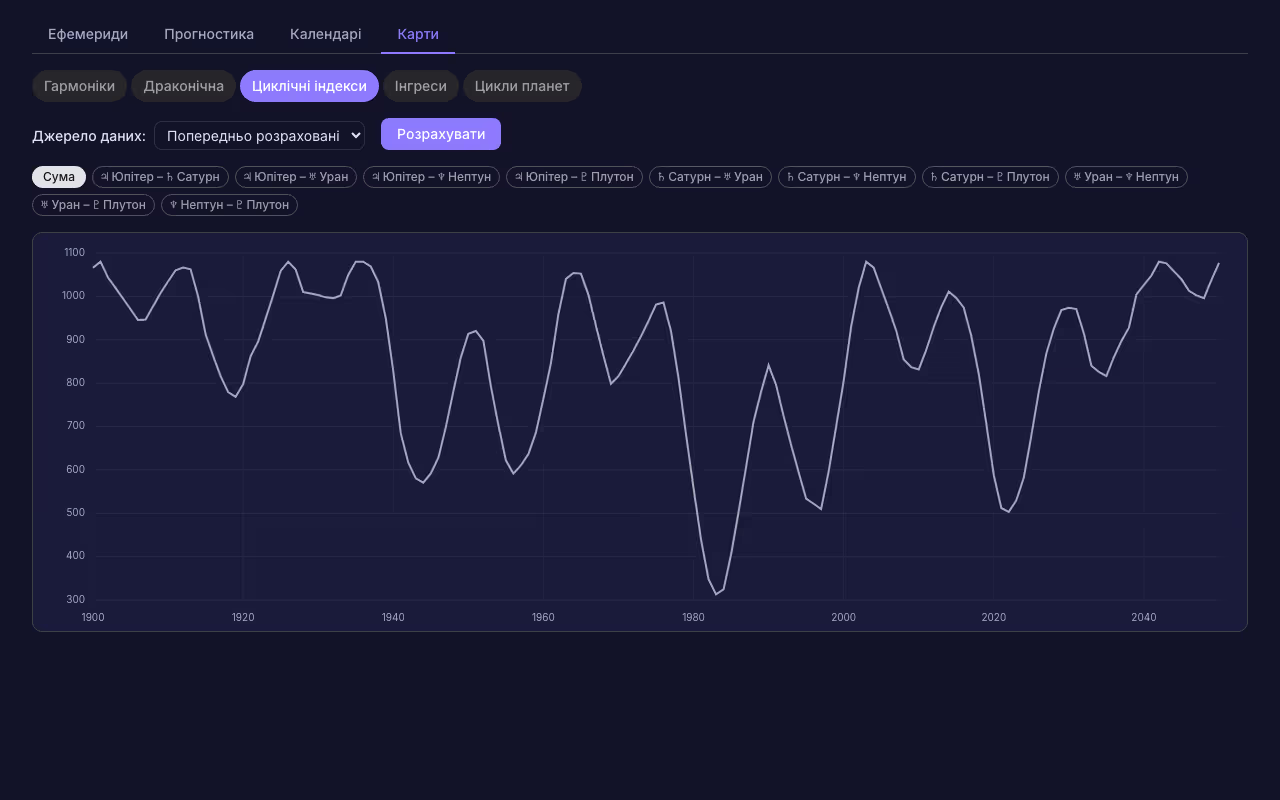
Cyclic indices are fundamental tools in mundane (world) astrology: - Barbault Cyclic Index: sum of all angular separations between Jupiter, Saturn, Uranus, Neptune, and Pluto - When the index rises - expansion, growth, optimism in world affairs - When the index falls - contraction, crises, restructuring - Graph plotted over decades or centuries - Planetary concentration/dispersion visualization - Historical correlation with major world events - Useful for long-term trend analysis - Based on André Barbault's research in mundane astrology

Barbo Index Explained

André Barbault proposed calculating the sum of angular distances between all pairs of slow planets: Jupiter, Saturn, Uranus, Neptune, and Pluto. Five planets yield ten pairs, and the sum of these distances becomes a single number for each date.

When the number is low, slow planets are clustered in one sector of the sky. When it is high, they are evenly spread out. Barbault correlated the minima of the index with periods of global crises and showed that they coincide with years of greatest tension, including 1914 and 1940.

How to Read the Chart

The important factor is not the absolute level, but the shape of the curve: a sharp drop to a minimum and the speed at which the index then recovers. The drop describes compression, the rise decompression, and it is at these transitions that history produces the most events.

Mundane astrology does not work with an individual and does not provide dates. The index reflects the background of the era, and it should be used as a scale of centuries, not as a forecast for a quarter.

  • Chart for any range of years
  • Planetary concentration as the second scale of the same phenomenon
  • Minima and maxima with dates and degree marks on the axis

Mundane Limitations

The Index does not refer to any country or event. It describes the tension of the general background, and any attempt to derive a specific forecast from it requires separate work with the cards of states, eclipses, and ingresses.

Correct practice is as follows: the index provides a framework for the period, and within this framework, narrower techniques work. The reverse order, when a suitable minimum is selected under a ready conclusion on the graph, gives the illusion of accuracy by hindsight.

Get started

Start Working in AstroWay App

Create your first natal chart in minutes. Free, precise, and private. 7-day PRO trial included.

Get started