∥ Parallel Aspects

Parallels and contra-parallels by declination: the second dimension of aspects where planets in different signs can be connected.

Parallel Aspects 1

Overview

Declination aspects - parallels and contra-parallels between planets, complementing classical aspects.

Declination Parallels

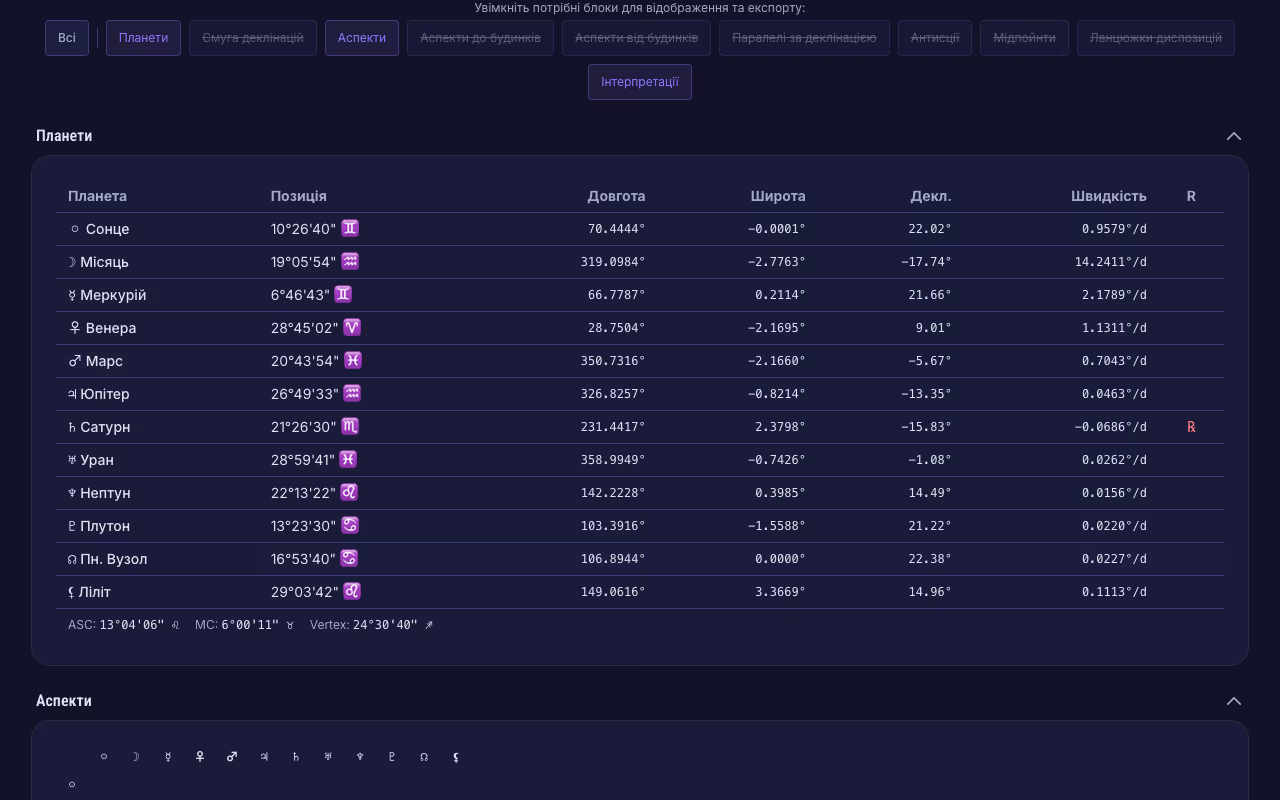
Ordinary aspects are calculated by ecliptic longitude, i.e. along the zodiac. Parallels operate in a different plane: they compare declination, i.e. the angular distance of a planet from the celestial equator, north or south.

Two planets in parallel have the same declination with the same sign; in contraparallel, the magnitude is the same but the sign is opposite. Longitude can vary, so parallel often connects planets not linked by standard aspect grids.

  • Parallel: same declination, both planets on the same side of the equator
  • Counter-parallel: same magnitude, opposite declination signs
  • Working orb is narrow, from 30 minutes to 1 degree.

Different Parallel Results

A planet's declination depends not only on its longitude but also on its ecliptic latitude. Because of this, two planets in different signs can have the same declination, and conversely: an exact conjunction in longitude does not guarantee a parallel.

The greatest discrepancies come from planets with high latitude: the Moon deviates up to 5°17', Pluto up to 17°. For them, parallel aspects regularly reveal connections invisible in a standard chart.

  • Declination depends on longitude and latitude of the planet.
  • Moon's deviation from the ecliptic is up to 5° 17'.
  • Pluto has the greatest latitude among the planets, up to 17 degrees.
  • The Sun has no latitude, so its declination depends directly on the sign.

Declination Bounds & Outer Planets

The Sun oscillates within approximately 23°26′, the tilt of Earth's axis. A planet whose declination exceeds this limit is considered out-of-bounds, and tradition ascribes it intensified, unbalanced action.

Such alignments occur rarely and almost always involve the Moon, Venus, Mars, or Pluto. They should be checked separately, as they are not marked in a standard chart.

  • Sun declination limit: approximately 23° 26′
  • Out-of-sign planet crosses this boundary due to latitude.
  • Moon, Venus, Mars, and Pluto are most often out of sign.

Reading Parallels in the Chart

Parallels are considered equivalent to conjunctions in strength, while contraparallels are akin to oppositions. This means a parallel amplifies and merges planetary themes, whereas a contraparallel creates tension between them.

The parallel does not cancel the regular aspect but adds to it. A square reinforced by a parallel operates more harshly than a simple square, and a trine with a contra-parallel turns out less smooth than it seems.

  • Parallel close to conjunction
  • Close to opposition
  • The parallel reinforces the aspect.
  • Parallel without longitude aspect explains unexpected connections.

Methods not working

The parallel has no direction and does not indicate which planet influences which, so it cannot be used to build a sequence of events. It is an indicator of connection, not mechanism.

Additionally, declination changes rapidly, so the parallel is sensitive to a birth time error even more than longitudinal aspects. With an inaccurate time, the list of parallels is unreliable.

  • The parallel does not show the direction of influence.
  • Sensitivity to time error is higher than in ordinary aspects.
  • List of parallels does not replace analysis of longitude aspects
Get started

Start Working in AstroWay App

Create your first natal chart in minutes. Free, precise, and private. 7-day PRO trial included.

Get started