📊 Ephemeris Graph

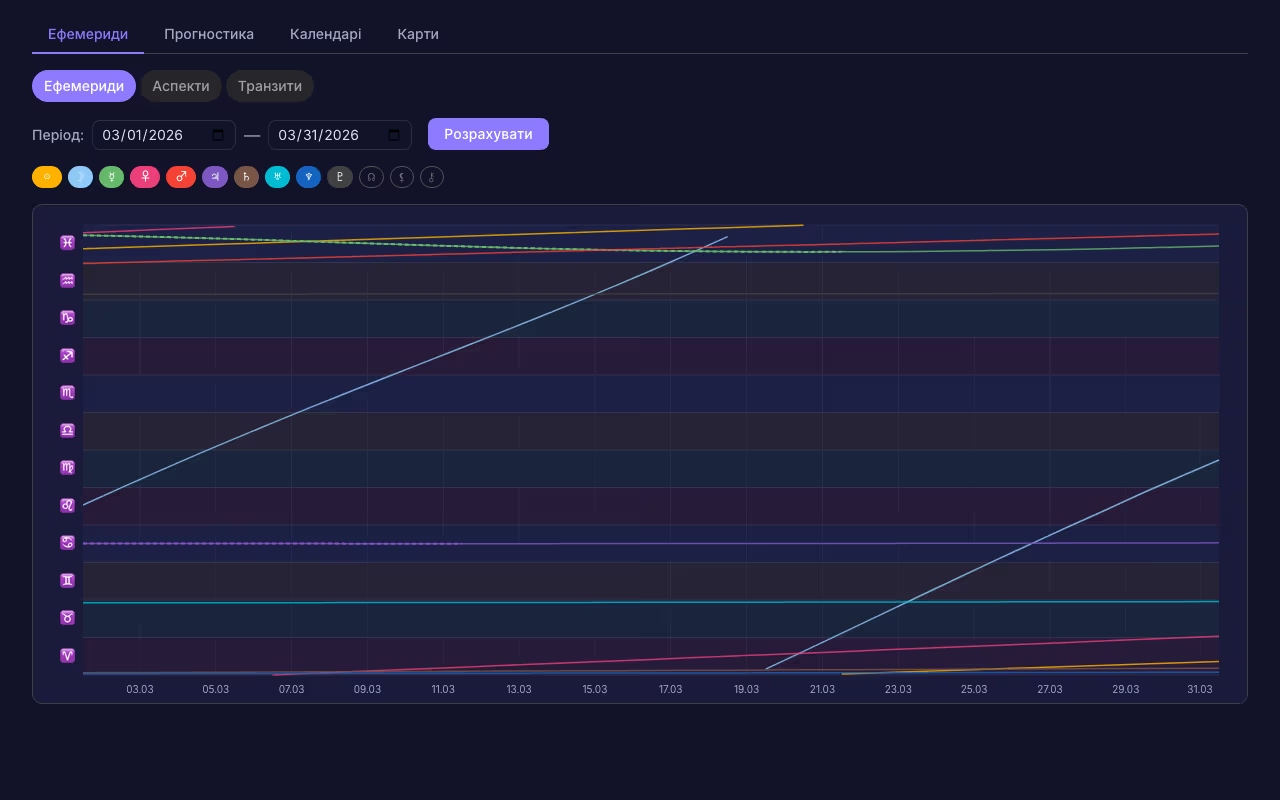
View planet movements as a graphical ephemeris - longitude plotted over time, showing retrograde loops, station points, and sign boundaries at a glance.

Ephemeris Graph 1

Overview

The graphical ephemeris displays planet positions as continuous curves across the zodiac: - Horizontal axis: time (days, weeks, months, or years) - Vertical axis: zodiac longitude (0°–360° or by sign) - Each planet drawn as a colored curve - Retrograde periods clearly visible as backward loops - Station points (direct/retrograde) marked - Sign boundaries shown as horizontal lines - Zoom into any time range for detail - Natal planet positions overlaid as horizontal reference lines - Useful for spotting clusters, patterns, and timing windows

Ephemerides

Ephemerides are tables of celestial bodies' positions at successive points in time. Classical printed ephemerides provide the longitude of planets at midnight or noon Greenwich Mean Time, and astrologers used them to manually construct charts even before the advent of computers.

Modern calculations rely on numerical theories of motion. The Swiss Ephemeris, based on NASA JPL’s DE431 model, covers the period from approximately 13000 BCE to 17000 CE.

  • Longitude, latitude, declination and speed for each moment
  • Swiss Ephemeris is based on the DE431 model.
  • Coverage range of over 30,000 years

Graphical Ephemeris

The graphical display shows planetary movement as curves on a time and longitude plane. The intersection of two curves is an exact aspect, while a horizontal segment represents a station-i.e., a pause before changing direction.

The most convenient form is a 45-degree or 90-degree chart: in it, conjunctions, squares, and oppositions align in a single line, so all hard aspects are visible at once.

  • Intersection of curves indicates an exact aspect
  • Horizontal section is a planet's station.
  • 90-degree chart brings hard aspects into one line

Accuracy and time systems

Astronomical calculations are conducted in ephemeris time, while civil time is coordinated universal time. The difference between them, delta T, is currently about 70 seconds, and for the seventeenth century it amounts to several minutes.

For the positions of slow-moving planets, this is not important, but for the Moon and for the chart angles in historical dates, the difference is noticeable. Therefore, ephemerides that do not account for delta T are unsuitable for ancient dates.

  • Delta T is now about 70 seconds and increasing
  • For historical dates, the correction reaches minutes
  • The Moon moves at 15 degrees per day, so it is sensitive to adjustment.

Ephemeris Data Used

In addition to longitude, the table provides latitude, declination, and speed. Speed is needed to determine retrograde motion and stations, declination for parallels and out-of-sign positions.

Separate entries include ingress times into signs, station dates, Moon phases, and eclipses. These are ready-made calendar events that would otherwise require searching through ephemerides.

  • Speed determines retrograde motion and station dates.
  • Declination is required for parallels and out-of-sign planets.
  • Latitude shows deviation from the ecliptic.

Practical Applications

Ephemerides are convenient where you need to see the process rather than a chart: when a planet enters the next sign, when it stations, or when it passes an important degree for the second time.

Overlaying natal degrees on the chart lets you instantly see which transits are approaching and in what order. It’s faster than checking dates one by one.

  • Entry dates into signs and stations:
  • Natal degrees as horizontal lines on the chart
  • Transit approach order is visible at a glance.
Get started

Start Working in AstroWay App

Create your first natal chart in minutes. Free, precise, and private. 7-day PRO trial included.

Get started