🌑 Eclipse Calendar

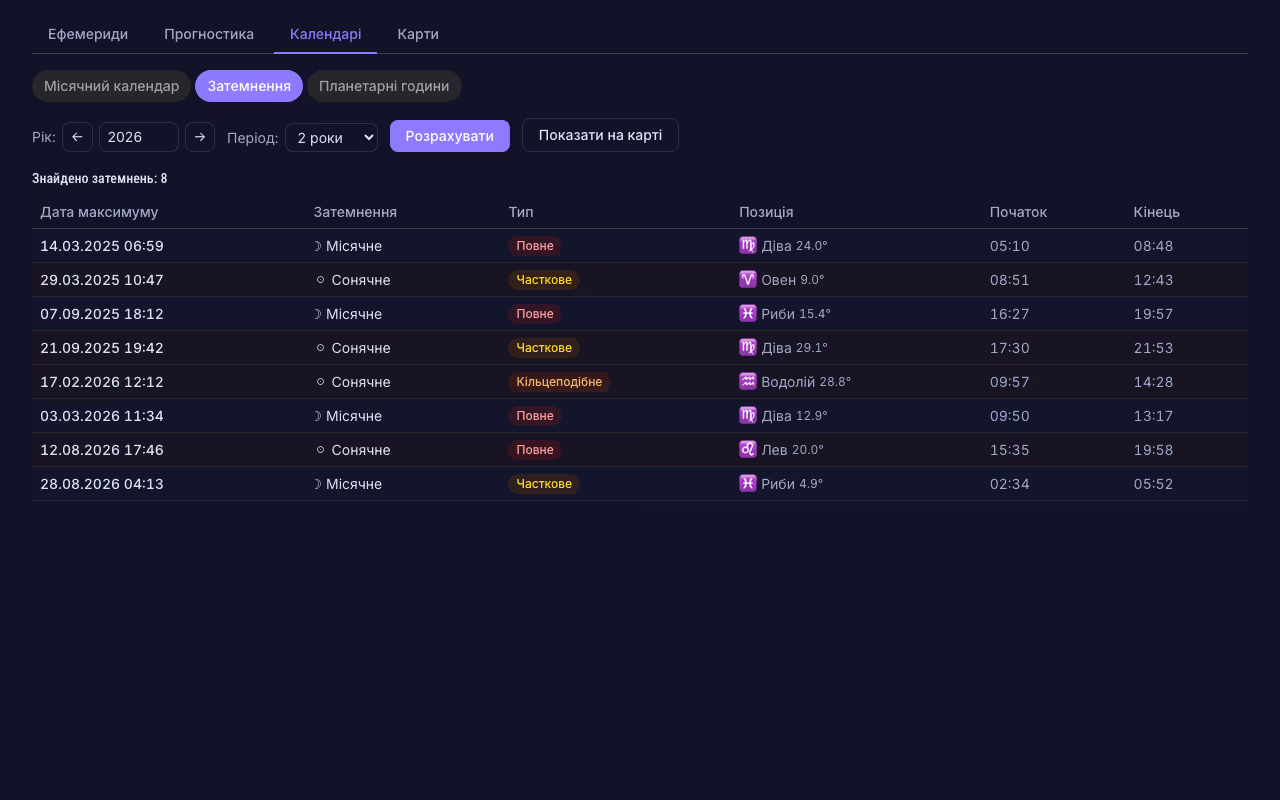
Find all solar and lunar eclipses for any period - with exact dates, eclipse types, magnitudes, and zodiac degrees for natal chart comparison.

Eclipse Calendar 1

Overview

The eclipse calendar lists all eclipses within your chosen time range: - Solar eclipses: total, annular, partial, hybrid - Lunar eclipses: total, partial, penumbral - Exact date and time of maximum eclipse - Zodiac degree of the eclipse point - Magnitude and gamma values - Saros series number - Compare eclipse degrees with natal planets - Eclipse paths visualized on the astrocartography map - Historical and future eclipses searchable - Essential for predictive astrology and mundane analysis

Why eclipses don't happen every month

The Moon's orbit is inclined to the ecliptic by approximately 5° 9′, so during most new moons the Moon passes above or below the Sun. An eclipse is only possible when a new or full moon occurs near the orbital node.

These periods are called eclipse seasons, occurring roughly twice a year and lasting about 34 days. There are between four and seven eclipses in a year.

  • The Moon's orbital inclination is 5° 9′.
  • Solar eclipse at New Moon near a node, lunar eclipse at Full Moon
  • 4 to 7 eclipses per year in two corridors

Saros and Repetition

Eclipses recur in series. A Saros is a period of 18 years, 11 days and 8 hours after which the geometry of the Sun, Moon and node is nearly identical, so the next eclipse in the series resembles the previous one.

An extra 8 hours shifts the visibility band by approximately 120 degrees of longitude, so the same eclipse series is seen in a different part of the world. One series lasts about 1200 years and includes more than 70 eclipses.

  • Saros: 18 years 11 days 8 hours
  • The band shifts by approximately 120 degrees of longitude.
  • The series lasts about 1200 years.

Eclipses in the Birth Chart

A significant eclipse is one that falls on a natal planet or an angle within an orb of approximately 2 degrees. An eclipse far from sensitive points of the chart passes unnoticed, despite general articles about its influence on everyone.

The house where the eclipse falls indicates the area of focus. The ruler of this house and the planet it touches clarify what exactly is happening.

  • Working orb for natal points is approximately 2 degrees
  • Eclipse house indicates the sphere; ruler clarifies the content.
  • Eclipses outside the orb are typically not reflected in the chart.

Timeframes

The classic rule ties duration to the phenomenon itself: for every minute the maximum phase lasts, it corresponds to months or years of influence. Modern practice often uses a simpler benchmark of six months to the next window.

Events often do not coincide with the eclipse date itself but with the moment when a transiting planet approaches the same degree. Therefore, it is worth keeping the eclipse date as a working degree for several months ahead.

  • Approximate action horizon until the next corridor, about 6 months
  • The event often coincides with a transit at the eclipse degree.
  • Lunar eclipses are traditionally considered to have a shorter duration than solar eclipses.

What Not to Do

Eclipses are not events in themselves and do not make the day dangerous for everyone. Claims that any activity is prohibited on such a day have no basis in either classical texts or practice.

A smart approach is to check the eclipse degree in your natal chart. If there are no sensitive points nearby, no specific actions are needed.

  • General warnings without reference to a chart are unfounded.
  • Check the degree in your natal chart
  • Eclipse visibility in your city does not affect chart interpretation.
Get started

Start Working in AstroWay App

Create your first natal chart in minutes. Free, precise, and private. 7-day PRO trial included.

Get started