
♃ Planetary Cycles

Explore the great planetary conjunctions - Jupiter-Saturn, Saturn-Pluto, and other cycles that mark turning points in history and collective experience.

Planetary Cycles 1

Overview

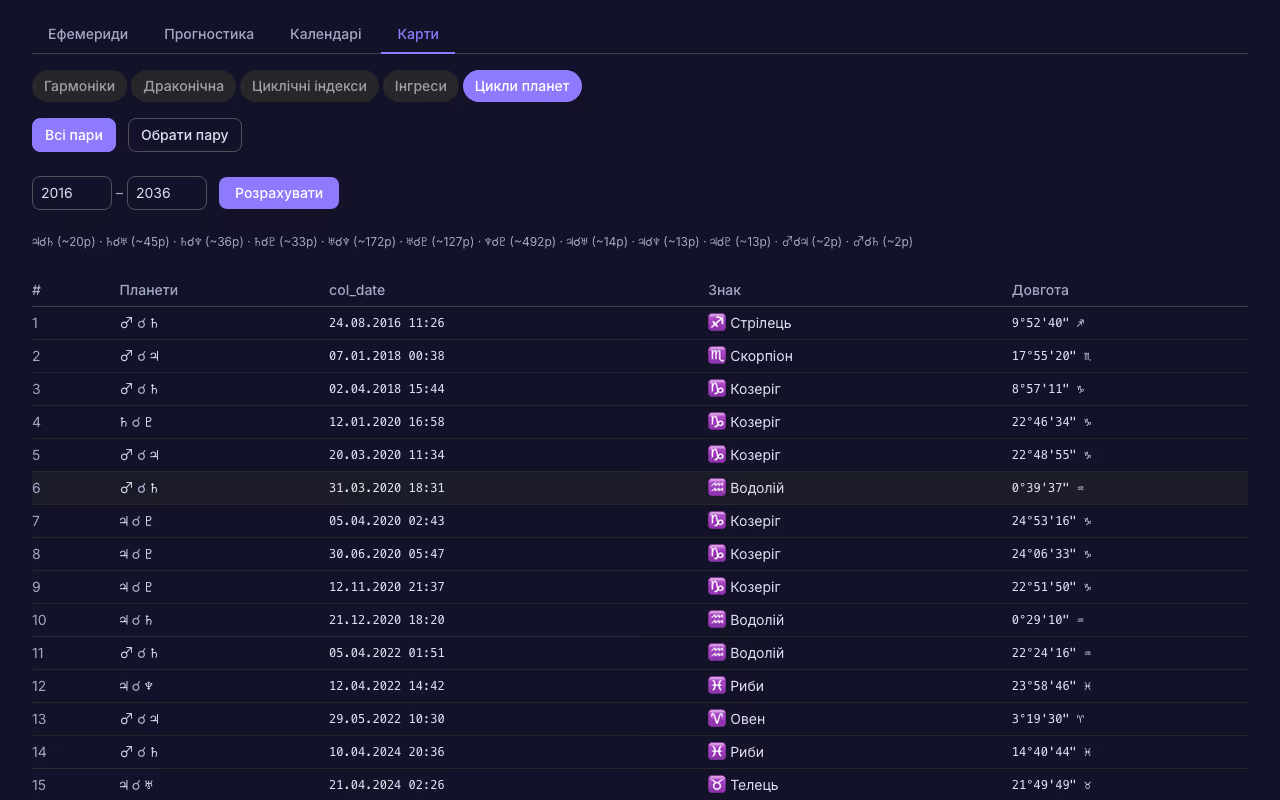
Planetary cycles track the conjunctions of slower-moving planets: - Jupiter-Saturn (~20 years): social and political shifts - Saturn-Uranus (~45 years): tradition vs. innovation tensions - Saturn-Neptune (~36 years): reality vs. ideals - Saturn-Pluto (~33 years): power restructuring - Jupiter-Pluto (~12 years): expansion of power - Jupiter-Neptune (~13 years): cultural and spiritual movements - Uranus-Neptune (~172 years): generational transformation - Uranus-Pluto (~127 years): revolutionary upheaval - Neptune-Pluto (~492 years): civilizational cycles - Exact conjunction dates with zodiac degrees - Historical timeline visualization

Synodic Cycle

The cycle of two planets is measured from their conjunction to the next conjunction. This interval is called the synodic period, and within it, the configuration passes through the same phases as the Moon: waxing, quadrature, opposition, waning.

This approach shifts focus from a single aspect to the entire process. The conjunction marks the beginning of the theme, the opposition the midpoint and maximum visibility, and the next conjunction the completion and a new start.

  • Conjunction: beginning of a cycle, the theme is not yet manifested
  • Waxing square: first crisis of action
  • Opposition: mid-point, maximum visibility of the result
  • Descending square: review and collapse

Main cycles length

The most famous cycle is Jupiter and Saturn with a period of about 19.86 years. In tradition, it marks the change of societal epochs, and the change of the element of conjunctions occurs approximately once every 200 years.

Slow pairs have rare cycles: Uranus and Neptune about 171 years, Uranus and Pluto about 127 years, Neptune and Pluto about 492 years. Such cycles are only observed on a historical scale.

  • Jupiter and Saturn: approximately 19.86 years
  • Saturn and Uranus: about 45 years
  • Uranus and Neptune: around 171 AD
  • Neptune and Pluto: approximately 492 years

Personal Cycles

In addition to cycles between planets, there are cycles of a planet returning to its natal position. Saturn Return occurs around 29.5 years, Jupiter Return every 12 years, and Uranus opposition to its natal position around 42 years.

These dates apply to all people of the same age, so they describe age-related transitions rather than individual fate. Individuality appears in which house and which aspects the cycle affects in a specific chart.

  • Saturn return at approximately 29.5 and 59 years
  • Jupiter returns every 12 years
  • Uranus opposition at about 42 years
  • Lunar Nodes return every 18.6 years

Retrograde within cycle

Retrograde loops cause the exact aspect to repeat three times within a cycle, and at the sign boundary it may occur five times. This stretches the phase over months and makes the timing less sharp.

To obtain exact phase dates, heliocentric positions are used: from the Sun’s perspective, there is no retrograde motion, and each phase occurs exactly once.

  • Three exact dates instead of one during retrograde loop
  • Heliocentric calculation gives one exact date for the phase.
  • For dating, it's more convenient to use a range rather than a single date.

How to Use

The main benefit of cycles is that they shift the conversation from a single date to a stage. The question isn’t what will happen on Monday, but which phase of the process you’re currently in.

It is practically useful to find the date of the last conjunction of a pair important for your chart and see what began then. The current phase will show what stage and story it is in.

  • Last connection date as the starting point
  • The cycle phase explains the stage, not the event.
  • Significant are cycles that touch natal degrees.
Get started

Start Working in AstroWay App

Create your first natal chart in minutes. Free, precise, and private. 7-day PRO trial included.

Get started