❓ Horary Astrology

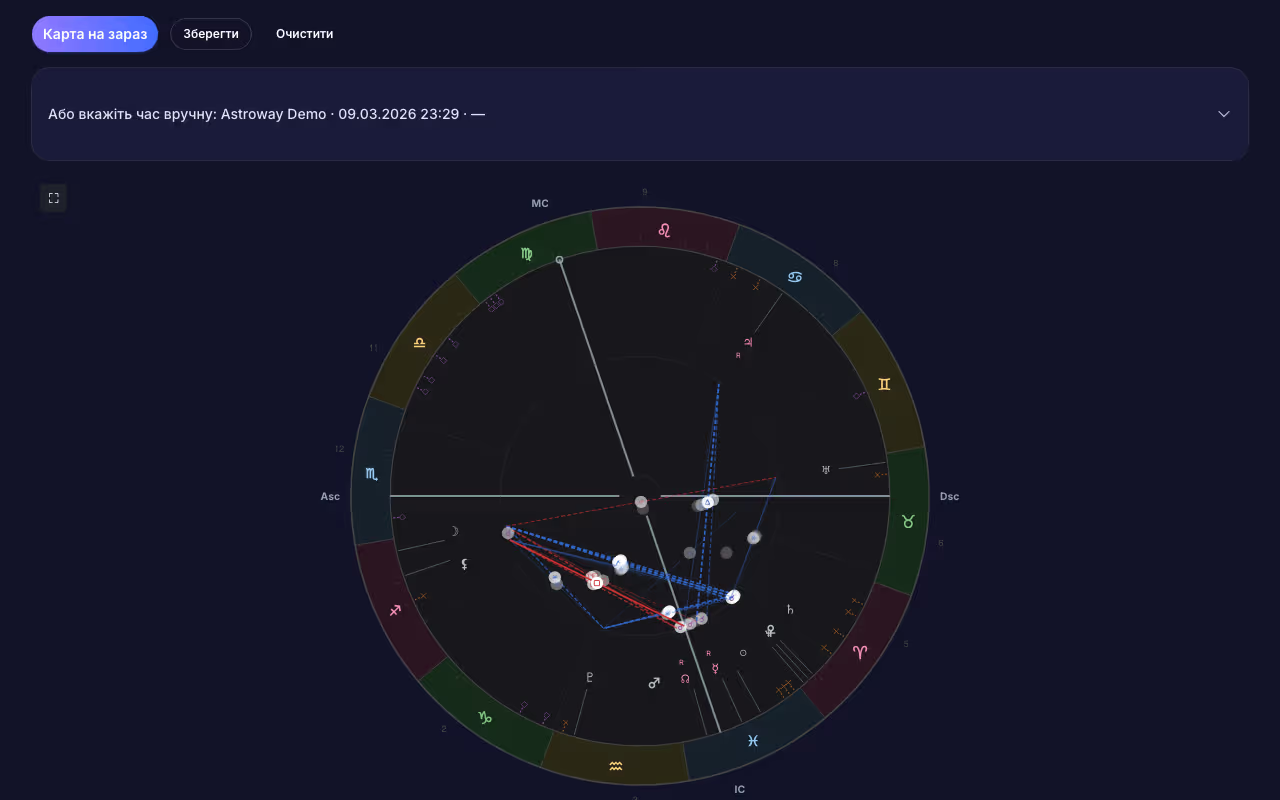
Cast a horary chart instantly for the current moment with automatic geolocation, traditional essential dignities, Moon void-of-course detection, and specialized horary presets.

Horary Astrology 1

Overview

Horary astrology answers specific questions by casting a chart for the moment the question is clearly understood. AstroWay makes this effortless: - One click to cast a chart for the current moment - Automatic coordinate detection via browser geolocation - Pre-configured horary presets (traditional rulerships, relevant aspects) - Full chart analysis with houses, aspects, and dignities

How It Works

When you ask a question: 1. Click "Now" to capture the exact moment 2. Your coordinates are detected automatically (or enter manually) 3. A full chart is calculated with traditional horary considerations 4. Analyze house rulers, receptions, and aspects for your answer The chart uses the same Swiss Ephemeris precision as natal charts - accurate to 1 arcsecond.

Houses in Horary

In horary astrology, houses represent the subjects of the question: - 1st house - the querent (person asking) - 7th house - the quesited (person/thing asked about) - 10th house - career, authority, outcome - 4th house - home, property, endings AstroWay supports all house systems used in horary practice, with Regiomontanus being the traditional choice.

Essential Dignities

Traditional dignity analysis is crucial for horary: - Domicile, exaltation, triplicity, term, face - Detriment and fall - Mutual reception between planets - Peregrine status Planetary sect (diurnal/nocturnal) and phase (oriental/occidental) are also displayed for traditional analysis.

Moon Void of Course

The Moon's void-of-course status is critical in horary: - Automatically detected and displayed - Shows when the Moon last made an aspect - Shows when the Moon will next change sign - A void Moon often indicates "nothing will come of the matter" Moon data is always prominent in horary charts for quick reference.

Horaire Chart

Horary astrology answers a specific question based on the chart drawn for the moment the astrologer understood the question. The querent's date of birth is not required at all.

The question should be one, specific, and truly meaningful. Abstract or verification questions are traditionally considered unsuitable, and the chart is usually not read for them.

  • Chart for the moment of understanding the question, not for the event itself.
  • Birth data is not used
  • One question per card

Radical Chart Check

The card is checked for suitability before the reading. Classic disqualifiers: Ascendant in the first 3 or last 27 degrees of a sign, Moon in Sagittarius according to some authors, Saturn in the 1st or 7th house.

This is not superstition, but a filter: early degree means the situation has not yet matured, late degree means it is already too late to resolve. A chart with striking aspects is best not judged and revisited later.

  • Ascendant up to 3 degrees: the question is not yet ripe
  • Ascendant after 27 degrees: the decision has effectively been made.
  • Saturn in the first house casts doubt on the question's motive.
  • Moon void of course: no significant events occur.

Significators

The querent is represented by the ruler of the 1st house; the subject of the question is represented by the ruler of the corresponding house: the 7th for a partner, the 2nd for money, the 10th for work, and the 4th for real estate.

The Moon acts as an additional significator of the querent, and its recent aspects indicate how the situation is developing. It is through the Moon that answers about timing most often arrive.

  • First House: the querent
  • House of the question topic: subject
  • Moon as the second significator and indicator of the process
  • Traditional management, without outer planets

How to read the answer

A positive response is given when significators converge in an applying aspect before either changes sign. Lack of an aspect typically means no.

They also consider the prohibition when the third planet manages to form an aspect earlier, and the transfer of light when a fast planet carries an aspect between two slow planets. These configurations reverse the answer.

  • Applying aspect between significators gives a positive response
  • Third planet's prohibition cancels conjunction
  • Light transmission enables connection where there is no direct aspect.
  • No aspect before sign change is read as refusal

Method Terms and Boundaries

Duration is calculated based on the number of degrees to the exact aspect, converted into time units depending on the angularity of the planets and the mobility of the signs. Cardinal signs yield fast durations, fixed signs yield slow ones.

The method is not universal: it works well on closed yes/no questions and poorly on questions about meaning or choosing from many options. Classic astrology advises against judging medical or fatal questions.

  • Degrees to aspect are converted to hours based on the movement of mutable signs.
  • Method suitable for closed questions
  • Tradition does not advise judging questions about life and death
Get started

Start Working in AstroWay App

Create your first natal chart in minutes. Free, precise, and private. 7-day PRO trial included.

Get started