♅ Uranian Astrology

Meridian 90° dial and midpoint structures of the Hamburg School - deep analysis of planetary pictures and symmetries.

Uranian Astrology 1

Overview

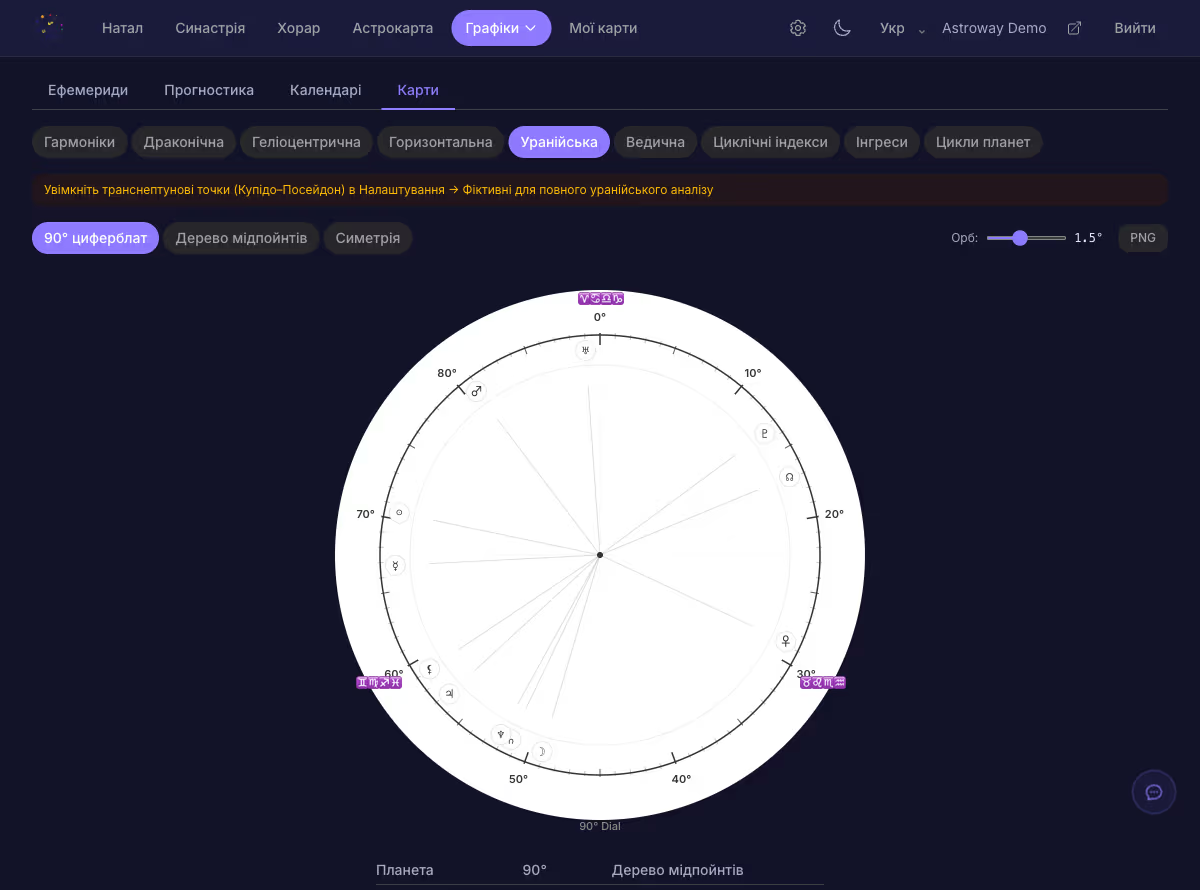
Uranian (Hamburg School) astrology - analysis through the 90° module: - 90° dial: all positions reduced to 90° (longitude % 90) - Planet pointers from center to position on the dial - Midpoint trees: for each planet - all midpoints it occupies - Planetary pictures: A = B/C (planet on the midpoint of two others) - Symmetries: A + B = C + D (matching midpoints in 90° module) - 8 transneptunian planets: Cupido, Hades, Zeus, Kronos, Apollon, Admetos, Vulkanus, Poseidon - Highlighting of exact structures (orb < 0.5°) - Interactive: hover and click on planets - Configurable midpoint structure orb - Export to PNG

90-degree zodiac wheel

The Hamburg School of Alfred Witte reduced the zodiac circle to 90 degrees: the longitude of each planet is taken modulo 90. As a result, conjunctions, squares, and oppositions-i.e., all aspects that are multiples of 90-merge into a single point and are interpreted as one connection.

This dial compresses the chart and reveals symmetries that are lost among aspect lines on a standard circle. Instead of listing aspects, the astrologer works with distances from the axis, and each planet gains neighbors that were not nearby in the tropical chart.

Midpoints and Planetary Pictures

The main unit here is not an aspect, but a midpoint, i.e., the midpoint between two planets. The notation Sun = Mars/Saturn means that the Sun is located midway between Mars and Saturn, and it is these formulas that form the language of the school.

The planetary picture is constructed as the sum of A plus B minus C: a third point is added to the sum of two points, and the planet is located at the resulting degree. This gives the exact degree of the event, not just an approximate zone, which is why the method was later adopted in mundane astrology.

  • Midpoint tree for each planet in the chart
  • Planetary aspects in the form A + B - C
  • Eight hypothetical trans-Neptunian points of the school

Trans-Neptunian Points

Vitte and Siggrun introduced eight hypothetical bodies: Cupid, Hades, Zeus, Cronos, Apollo, Admetos, Vulcanus, Poseidon. Astronomically, they are not confirmed, and the school uses them as symbolic points with fixed orbits.

Treat them as symbolic markers within the method. If you work in the classical tradition, the dial and midpoints can be used even without trans-Neptunian points: most techniques will remain unaffected.

Get started

Start Working in AstroWay App

Create your first natal chart in minutes. Free, precise, and private. 7-day PRO trial included.

Get started