📅 Transit Calendar

Exact ingress, culmination, and egress dates for each transit, including retrograde returns.

Transit Calendar 1

Overview

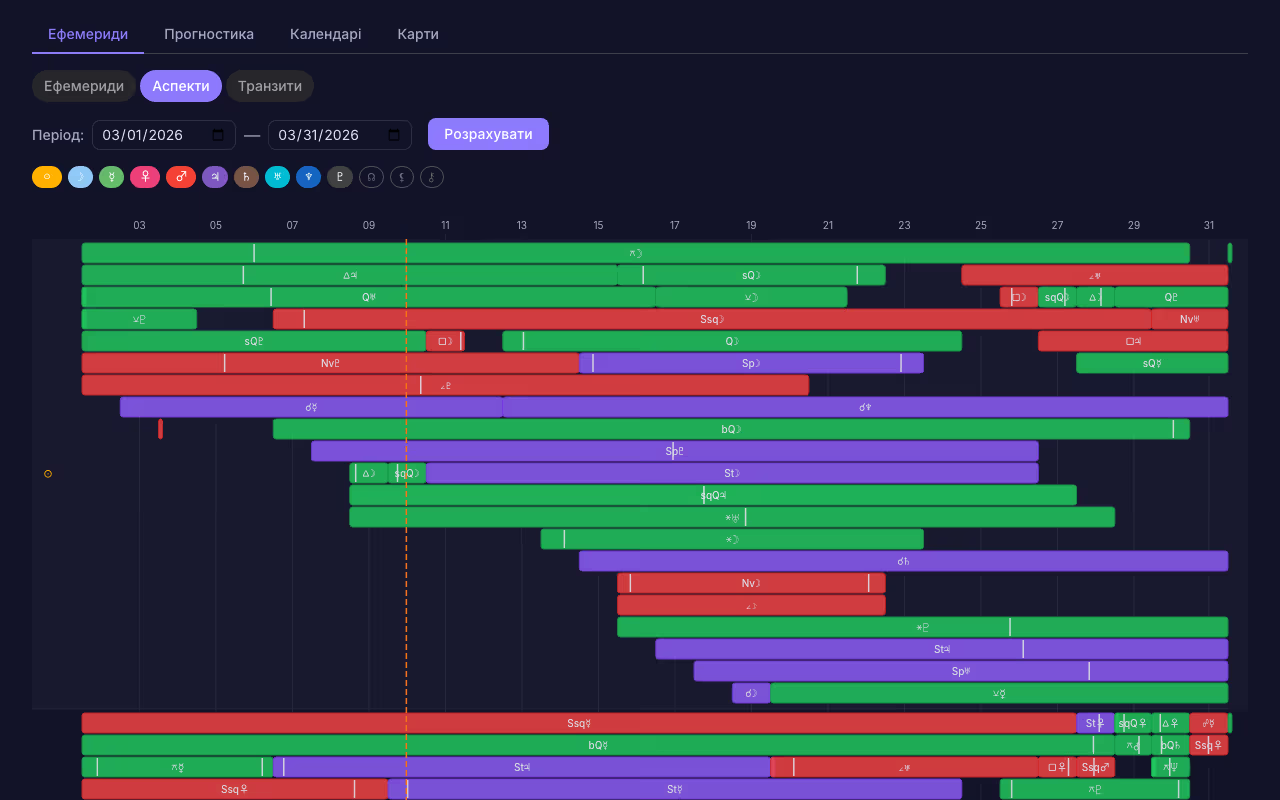
Calendar of exact transiting planet aspects to natal - diary of key astrological events.

Transit Calendar

The calendar converts the continuous movement of planets into a list of events with dates. Instead of rebuilding the chart daily, you immediately see when a transiting planet enters orb with the natal one, when the aspect becomes exact, and when it separates.

Precise timing is key: most forecasting techniques rely on the exact aspect date, not the entire influence period.

  • Entry date into orb, exact aspect date, exit date
  • Filter by planets, aspects, and orb size
  • Transits to natal planets, angles, and houses

Exact Aspect, Separation

An approaching aspect is considered effective in classical astrology, while a separating one is already past. This is not a stylistic detail: the event most often occurs during the applying phase or at the exact degree, not during separation.

The orbis for transits is narrower than in natal charts. A reasonable limit for slow planets is 1 degree, and 30 minutes is sufficient for the Moon; otherwise, the calendar becomes cluttered with noise.

  • Planet approaching, aspect intensifying
  • Exact aspect: 0° orb, peak date
  • Separation: the topic has already manifested and is fading.
  • Transit working orb is 1 degree, for the Moon 30 minutes

Retrograde and Triple Pass

When a planet becomes retrograde after an exact aspect, it returns to the same point and passes it two more times. This results in three exact dates instead of one, spread over several months.

This practically means the issue is not resolved on the first try: the first pass raises the question, the retrograde returns to it, and the third closes it. For Saturn, such a cycle takes about 9 months, for Jupiter about 4.

  • Three exact dates instead of one during retrograde loop
  • Saturn: triple transit lasts approximately 9 months
  • Outer planets can make five passes at the sign boundary.

Fast and slow planets

The Moon completes its orbit of the chart in 27.3 days and forms an aspect daily, so its transits describe the day’s mood rather than a specific event. The Sun, Mercury and Venus operate on a scale of weeks.

Structural-level events are tied to Saturn, Uranus, Neptune, and Pluto: they pass 1° every 1 week or 1 month, so their aspect aligns with a prolonged period rather than a specific date.

  • Moon: 27.3 days per orbit, day scale
  • Sun, Mercury, Venus: weekly forecast
  • Mars completes its orbit in about 2 years, Jupiter in about 12, Saturn in about 29.5.
  • Pluto will transit the zodiac degree for several years.

Plan by Calendar

A calendar is useful as an attention filter, not as a life schedule. A smart way to work is to mark two or three most important dates of the month and not try to account for all aspects in a row.

Transits do not act alone: if the natal planet is not involved in the theme, its transit almost changes nothing. First, we look at what the planet rules in the chart, and only then at the aspect.

  • Two or three key dates per month instead of the full list
  • Managing the natal planet is more important than the name of the aspect.
  • The convergence of several transits on a single date is more significant than a single strong one.
Get started

Start Working in AstroWay App

Create your first natal chart in minutes. Free, precise, and private. 7-day PRO trial included.

Get started