☾ Lunar Return

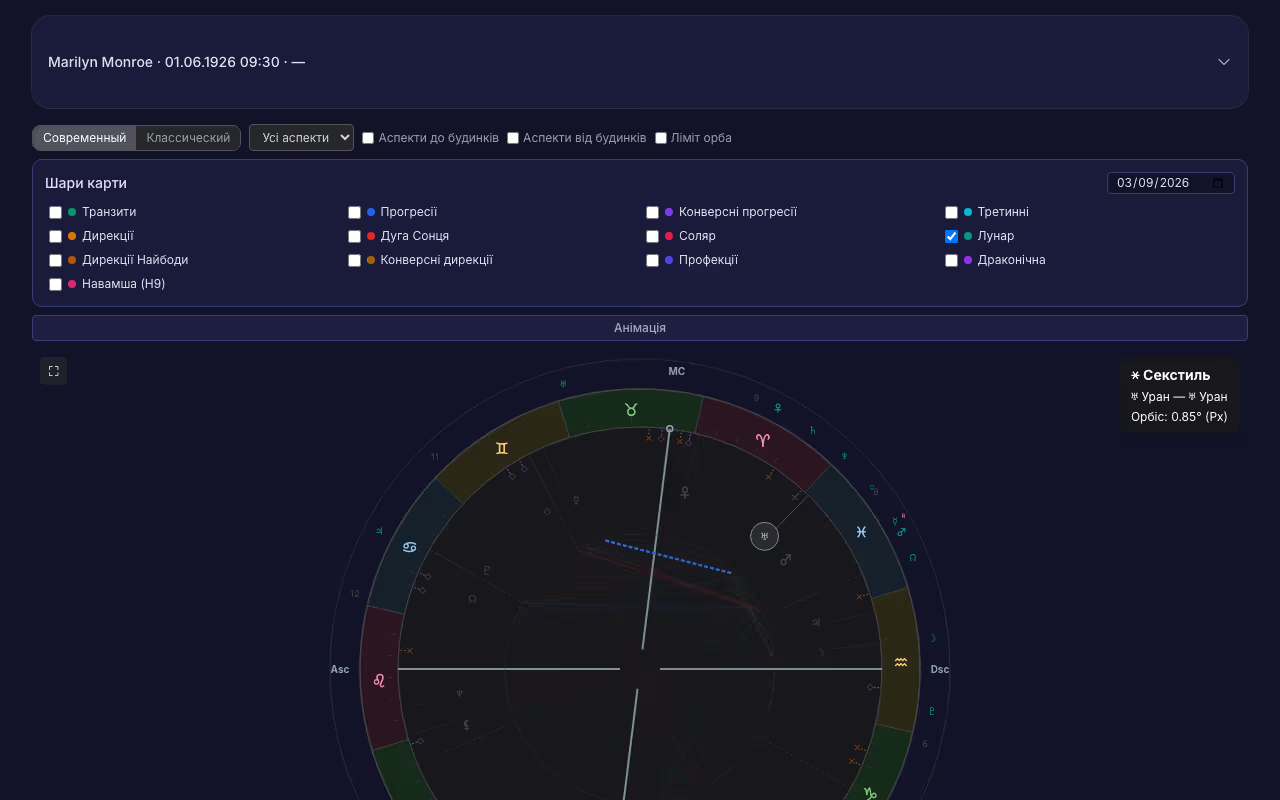
The lunar return chart marks the Moon's monthly return to its natal longitude - providing a detailed snapshot of the upcoming lunar cycle's themes and events.

Lunar Return 1

Overview

A lunar return chart is calculated for each month when the Moon returns to its natal position: - Precise calculation of the Moon's return moment - Cast for birth location or current residence - Full chart with houses, aspects, and all planets - Particularly useful for short-term forecasting (month ahead) - Compare with natal chart for monthly themes - Navigate between months - Works well combined with solar return for layered analysis - Export reports to PDF or DOCX

Lunar Cycle

A Lunar is a chart for the moment when the transiting Moon returns exactly to the longitude it occupied at birth. Since the Moon completes its orbit in 27.32 days, a Lunar is constructed roughly once a month, resulting in 13 for the year.

The chart describes the month from one return to the next. This is the shortest of the classical returns, so it works well for everyday planning and poorly for major life themes.

  • Sidereal month: 27.32 days, 13 lunations per year
  • Arc-second precision, minute difference shifts angles.
  • The period runs from the return to the next, not the calendar month.

Best Location for Birth Chart

The same question as in the solar: place of birth or place of actual residence. Most schools practice building the lunar chart for the city where the person will actually be at the time of return.

The difference is not cosmetic. The planets will remain in the same longitudinal positions, but the Ascendant and Midheaven will change completely, along with all the houses. For a short chart, this is the main change.

  • Planets are the same everywhere, houses depend on location.
  • Build based on actual location at return time
  • You can check the version using past months with known events.

Lunar reading suggestions

Standard order: the lunar Ascendant and its ruler set the tone for the month, the Moon’s house position shows where attention will focus, and the strongest planet near an angle gives the main theme.

The most important factor is the overlay on the natal chart. If the lunar Ascendant falls on a natal planet or a natal angle, the month will be noticeable. If not, it will most likely pass quietly.

  • Ascendant in Cancer and its ruler set the tone
  • Moon's House shows the sphere of main focus
  • A planet near the lunar angle brings its theme to the forefront.
  • Lunar angle aspects to natal points sharply increase the Moon's significance.

Lunar with Solar

Lunar is not an independent forecast, but a detailed analysis. Solar sets the year, lunar shows in which exact month the solar theme will manifest. Reading lunar without solar means seeing a fragment without context.

It practically works like this: in the solar chart, we find the leading theme of the year, then we look for a lunar chart in which the same theme falls on an angle. This will be the month of implementation.

  • Solar return sets the year, lunar return specifies the month
  • The solar return theme activated at a lunar return angle provides a month of manifestation
  • A lunar chart without reference to the natal and solar charts is not very informative.

Method boundaries

The Lunar describes the month and doesn't see further. It doesn't show long processes, doesn't replace transits of slow planets, and doesn't provide grounds for decisions the consequences of which will stretch for years.

Due to the short duration, the chart is very sensitive to the accuracy of the birth time: an error of several minutes shifts the return moment and completely changes the lunar houses.

  • Forecast horizon: 1 month
  • Transits of Saturn and the outer planets are not replaced.
  • Birth time error distorts houses more than in the solar chart.
Get started

Start Working in AstroWay App

Create your first natal chart in minutes. Free, precise, and private. 7-day PRO trial included.

Get started