▦ Aspect Tables & Interpretations

Explore every aspect in your chart through detailed tables - aspect grid with exact orbs, midpoint analysis, and multi-author interpretation texts for deeper understanding.

Aspect Tables & Interpretations 1

Overview

The aspect tables provide a comprehensive view of all planetary interactions in the chart: - Full aspect grid showing every planet pair with exact orb values - Color-coded by aspect type (conjunction, trine, square, etc.) - Applying/separating status for each aspect - Midpoint table with sorted midpoints and their interpretations - Multiple interpretation text collections from different astrological authors - Filter aspects by type, orb range, or planet - Export tables to PDF or DOCX for consultations

Chart Tables Overview

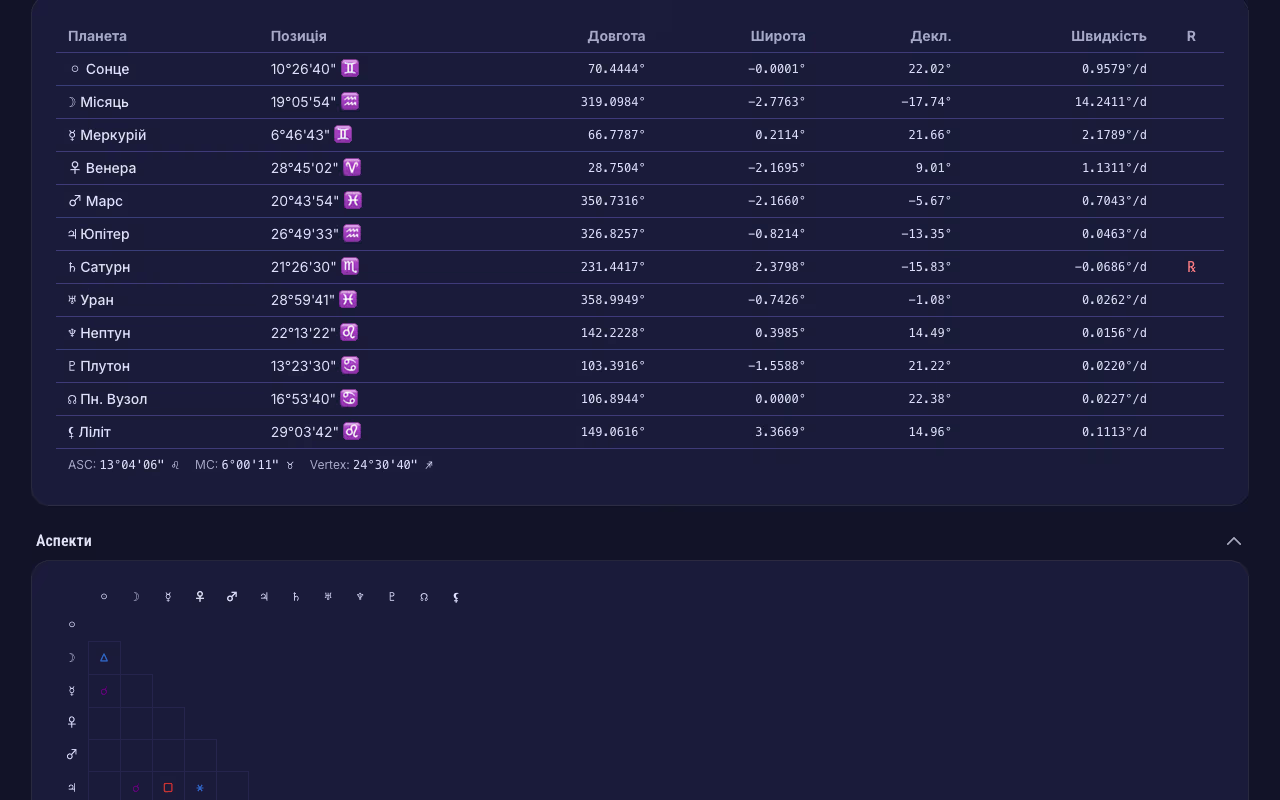
The chart wheel provides a general impression but makes precise numbers hard to read. Tables present the same data numerically: longitude to the second, speed, declination, house, and aspects with orbs.

To verify calculations and work with tight orbs, tables require: a 20 arc-minute difference is imperceptible on the wheel but affects the interpretation.

  • Longitude, latitude, declination and speed of each planet
  • House and sign with exact degree
  • Aspects with actual orb, not just a mark

Essential Dignities

The Essential Dignities table shows how strong a planet is in a sign. The classic scheme includes domicile, exaltation, triplicity, terms, and faces, as well as detriment and fall marked with a minus sign.

Lilly's final score consists of all levels. A planet in domicile receives 5 points, in exaltation 4, in triplicity 3, in terms 2, in face 1, in detriment -5, in fall -4.

  • Abode 5 points, exaltation 4, triplicity 3
  • Term 2, faces 1
  • Exile minus 5, Fall minus 4
  • The summary shows how capable the planet is of acting independently.

Accidental Indicators

In addition to the sign, the planet's position in the chart is considered: house, proximity to angles, speed, direction of movement, visibility, and distance from the Sun. These are accidental dignities, describing not quality but the potential to act.

A planet may be strong by sign yet combust or hidden in the 12th house, sharply reducing its ability to manifest externally despite a high essential dignity score.

  • The angular house strengthens; a cadent house weakens the manifestation.
  • Burning at a distance from the Sun of less than 8°30′
  • Up to 17 minutes from the Sun's center is considered strong.
  • Retrogradation is traditionally considered a weakening.

Aspects Table

The Aspect Matrix shows all pairs at once with the actual orbis. This quickly reveals exact aspects within 1°, which on the wheel are lost among the wide ones.

Here you can see the application and separation: a planet approaching is more effective in classical astrology, and without the speed number this cannot be determined.

  • Actual orb for each aspect in degrees and minutes
  • Application or separation by planetary speeds
  • Exact aspects within 1° are highlighted immediately

How to use

Smart order is this: first the table of dignities to understand which planets in the chart are strong, then the aspect matrix for precise connections, and only then the wheel for the overall picture.

Tables are also needed to verify someone else's calculation. A discrepancy in the house system or ayanamsa is immediately visible in the numbers, while it can easily go unnoticed on the wheel.

  • Strengths show which planets to rely on.
  • Aspect Matrix provides exact connections
  • Numbers show discrepancies in calculation settings.
Get started

Start Working in AstroWay App

Create your first natal chart in minutes. Free, precise, and private. 7-day PRO trial included.

Get started